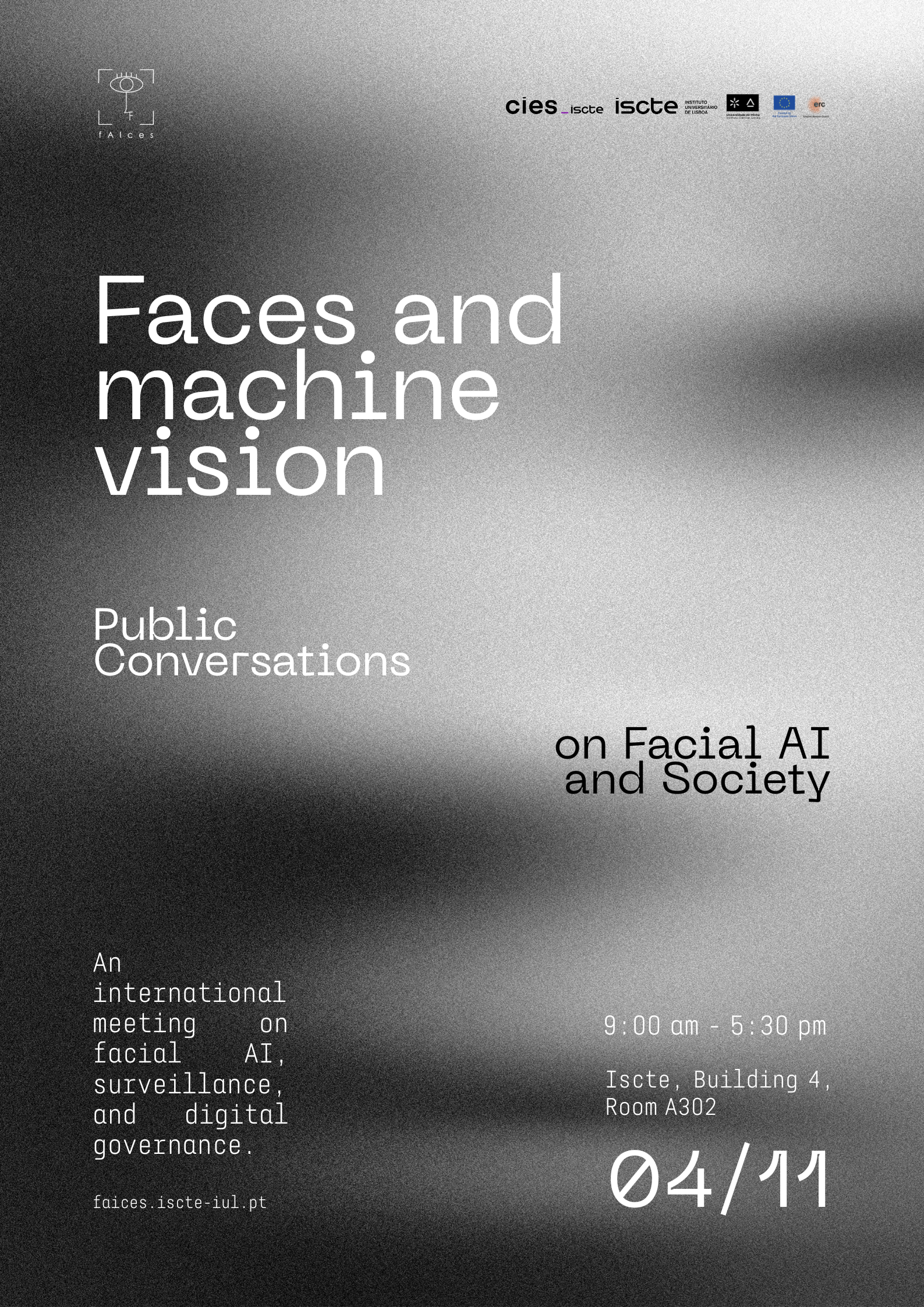
DATE 4 November
TIME 9.00 am–5.00 pm
VENUE Iscte, Building 4, Room A302
▶ PROGRAMME ▶ BOOK OF ABSTRACTS
Facial recognition and other forms of facial AI are increasingly used by the police and in border control, on smartphones and digital platforms, in healthcare and education, as well as in a growing range of everyday contexts. In this context, facial AI broadly refers to AI-based systems that detect, analyse or infer information from faces, such as identification/verification, categorisation, inference of emotions/affects, attention and behaviour analysis, and other predictive or profiling applications.
This conference brings together a diverse international group of experts in the social sciences and humanities — spanning Science, Technology and Society (STS) studies, semiotics, art and cultural studies, public policy, design, visual culture and surveillance studies — to discuss a timely and urgent question: what is at stake when facial AI makes the face a fundamental interface for decision-making, governance and everyday life?
This event explores how computer vision reshapes what is considered ‘visible’ (and what becomes invisible); how design choices embody power and assumptions; how masks, avatars and algorithmic ‘faciality’ reshape identity and recognition; how surveillance systems reproduce racial and gender inequalities; how computational approaches can help map public controversies; how cultural histories and narratives of AI influence what becomes conceivable or inevitable; and what ‘responsible’ governance might look like in practice.
Guiding questions include: What does it mean to be ‘seen’ by a machine? Who defines what is visible, measurable and actionable? Which inequalities are amplified and under what conditions? How do surveillance systems become normalised within institutions (schools, campuses, workplaces)? How does a feminist/decolonial approach change the way in which risk, security and ‘user needs’ are defined? What are the alternatives to facial recognition beyond a simple ‘ban versus allow’ framework? How can artistic and creative practices help the public to imagine and debate different futures?