- News
- Events
- Recurring Events
- Biographies and Trajectories
- Cidades & Impérios: dinâmicas locais, fluxos globais
- Cultural Diversity in Contemporary Families
- Meetings on China Studies
- Meetings Migration Experiences
- Social studies on science and the circulation of knowledge
- Public Policy Forum
- Research Forum CIES
- Gender, Sexuality and other social markers of difference
- Language, Power, and Social Boundaries
- ETNO.URB Readings
- Social Movements and Political Action
- New Perspectives on Modern History
- Revisiting the 19th Century
- Research Workshops
- Methodological Innovation Workshops
- Calls
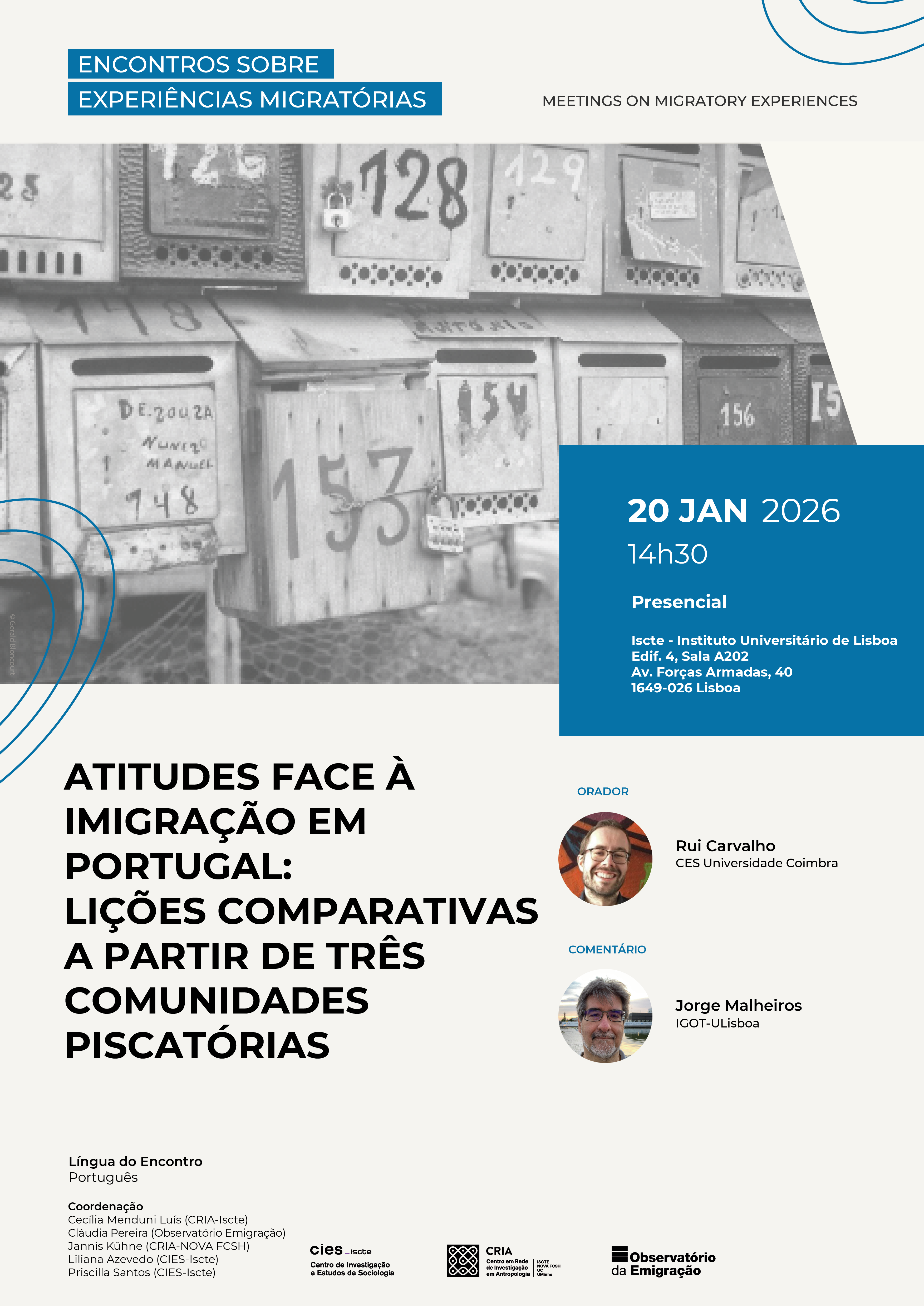
The first Meeting on Migratory Experiences 2026 will take place on January 20, at 2:30 p.m., in Room A202, Building 4, at Iscte – University Institute of Lisbon.
The meeting will feature Rui Carvalho (CES–Coimbra), who will speak on attitudes toward immigration in Portugal based on three fishing communities, with commentary by Jorge Malheiros (IGOT–ULisboa).
ABSTRACT
European countries have received a growing number of international migrants in recent years. In this context, there has also been a progressive politicization of immigration and an increase in negative attitudes toward immigration and immigrants in these countries. Portugal is no exception to these trends. This paper reports the results of a study on attitudes toward immigration and immigrants in three fishing communities in Portugal, all of which have received significant contingents of immigrants in recent years. According to existing theories, these communities should be characterized by strong opposition to immigration and immigrants (e.g., economically disadvantaged; characterized by strong community ties; and traditionalist values), particularly toward immigrants mostly originating from Southeast Asia (e.g., strong racial, religious, and linguistic differences in relation to native communities). However, contrary to these expectations, public opinion—including within the fishing sector—toward these immigrants has been:(a) predominantly positive, and (b) marked by significant variation across host fishing communities. Using several qualitative methods, including comparative fieldwork in three fishing communities with different trajectories, it was possible to identify three explanatory factors for these results. First, the existence (or lack) of a local organizational fabric with strong mobilizing capacity in favor of incorporating these migrants into the activity spaces of local populations. Second, the dynamics and patterns of integration, as opposed to residential and activity-space segregation (e.g., professional, community) of these migrants. Third, and partly as a consequence of the previous factors, the existence of opportunities for establishing (positive) interethnic contact between immigrants and the local native population. The paper discusses the implications of these findings for theories and policies regarding attitudes toward immigration and immigrants in Europe.
BIOGRAPHIES
Author
Rui F. Carvalho (Centre for Social Studies, University of Coimbra). Sociologist (PhD, Brown University), geographer (BSc, NOVA University of Lisbon). My research focuses on issues of community and urban development, international migration, ethnic and racial minorities, and sociological theory. My doctoral project analyzed how racial inequalities, together with other sources of inequality, influence the aspirations and capacities for international migration among Brazilians. In addition to continuing this line of research, my current projects examine attitudes (and opposition) toward immigrants and immigration, as well as ecological crises, in the European context. Most of this work is being developed within the CO3 project (Centre for Social Studies, University of Coimbra). In line with my previous research areas, my teaching interests include themes such as migration and development, ethnic and racial inequalities, urban studies, and research theories and methods. In my teaching experiences, I have frequently used pedagogical tools based on community work and the arts (Hip-Hop).